
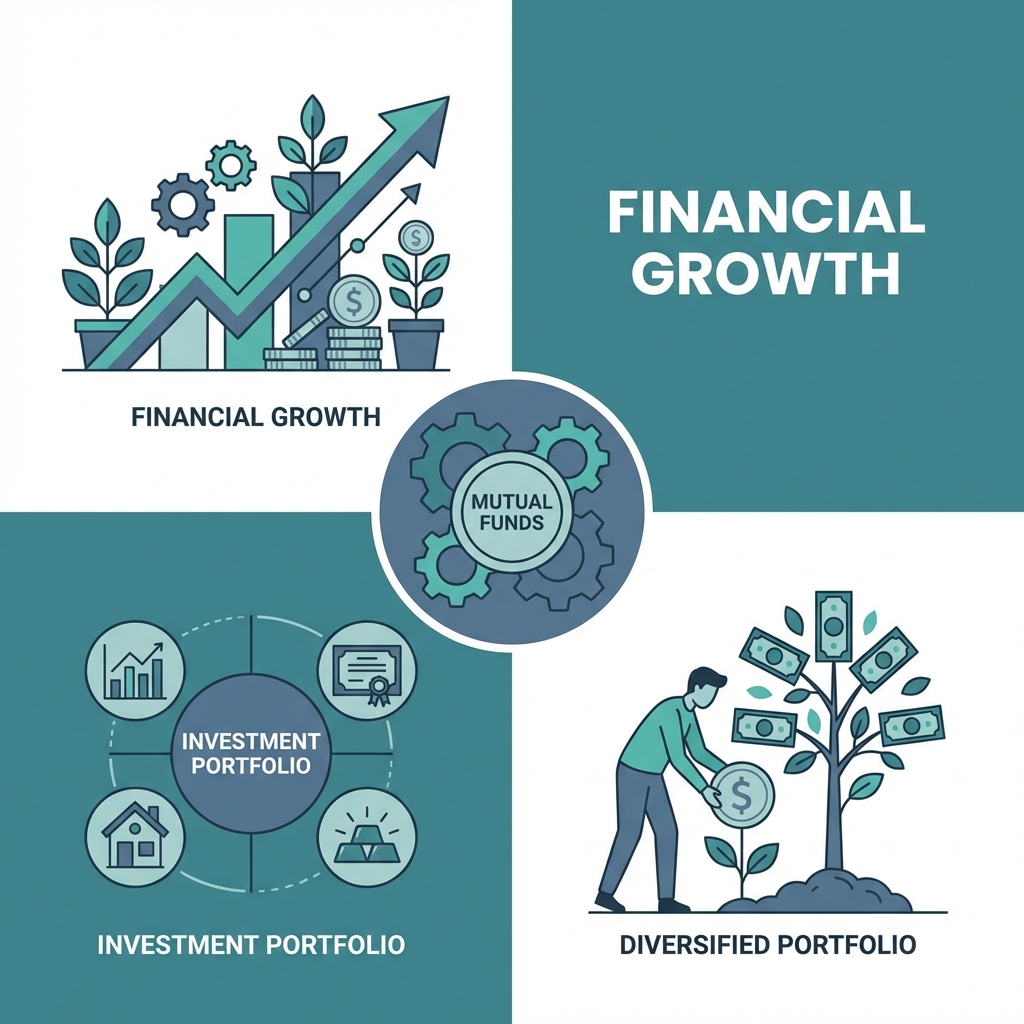
With over 2,500 mutual fund schemes available in the market today, picking the "best" one can feel like finding a needle in a haystack.
Most beginners make a classic mistake: they open a finance app, sort funds by "Highest 1-Year Returns," and invest in the top result.
This is a recipe for disaster.
The top-performing fund of 2023 is rarely the winner in 2024. In fact, chasing past performance is the #1 reason retail investors underperform the market benchmarks.
Professional wealth managers don't guess. They follow a structured process.
In this guide, we’re going to hand you that process. This is the 5-Step Framework to build a winning mutual fund portfolio that sleeps well at night and grows wealth over decades.
Step 1: Define Your "Why" (Goal-Based Investing)
Before you look at a single fund, you must look at yourself. Why are you investing?
A fund that is perfect for your retirement (20 years away) is terrible for your wedding goal (2 years away).
Match Your Goal to the Category
| Time Horizon | Goal Example | Recommended Fund Category | Risk Level |
|---|---|---|---|
| Short Term (< 1 Year) | Emergency Fund, Vacation | Liquid Funds or Overnight Funds | Very Low |
| Medium Term (1-3 Years) | Car Purchase, Home Downpayment | Short Duration Debt or Arbitrage Funds | Low |
| Long Term (5-7 Years) | Children's Education | Flexi Cap or Large & Mid Cap Funds | Moderate-High |
| Ultra Long Term (10+ Years) | Retirement, Wealth Creation | Mid Cap or Small Cap Funds | High |
Pro Tip: Use our SIP Calculator to determine exactly how much you need to invest monthly to hit these goals.
Step 2: Assess Your Risk Tolerance
Risk isn't just a disclaimer; it's a measure of how much emotional pain you can handle.
Ask yourself: "If my portfolio drops 20% next week, what will I do?"
- Panic and Sell? → You are a Conservative investor. Stick to Large Cap Index Funds or Hybrid Funds.
- Worry but Hold? → You are a Moderate investor. A mix of Flexi Cap and Large Cap funds is ideal.
- Buy More? → You are an Aggressive investor. You can handle the volatility of Mid and Small Cap funds for higher potential returns.
Step 3: Analyze Consistency, Not Just Returns
Don't look at the CAGR (Compound Annual Growth Rate) in isolation. A fund might show 20% CAGR because it doubled in one lucky year after flatlining for four.
Instead, look for Rolling Returns. This metric shows how the fund performed across every possible 3-year or 5-year period in its history, not just point-to-point.
Key Metrics to Check:
- Alpha: Measures the excess return the fund manager generated over the benchmark index. A positive Alpha (>0) means the manager is adding value.
- Beta: Measures volatility compared to the market. A Beta of 1.0 means it moves with the market. A Beta of 0.8 means it falls less than the market during crashes (which is good).
Rule of Thumb: Look for a fund with High Alpha and Low Beta. This indicates high returns with lower risk.
Step 4: The Hidden Cost of Fees (Expense Ratio)
The Expense Ratio is the annual fee the fund house charges you to manage your money. It sounds small—usually between 0.5% and 2.0%—but over 20 years, it eats a massive chunk of your wealth.
Regular vs. Direct Plans
Every mutual fund comes in two flavors:
- Regular Plan: Includes a commission for the distributor/agent.
- Direct Plan: No commissions. You invest directly with the fund house (or via zero-commission platforms).
| Feature | Regular Plan | Direct Plan |
|---|---|---|
| Expense Ratio | Higher (~2.0%) | Lower (~0.8%) |
| Commissions | Paid to Agent | Zero |
| NAV | Lower | Higher |
| 20-Year Returns | Lower | Significantly Higher |
The Verdict: Always choose the Direct Plan. The 1% saved annually compounds into lakhs of extra rupee over the long term.
Step 5: Check for Portfolio Overlap
If you buy 4 different "Top Rated" Large Cap funds, you might think you are diversified. In reality, you probably own shares of HDFC Bank, Reliance, and ICICI Bank four times over.
This is called Portfolio Overlap.
Buying multiple funds with the same underlying stocks doesn't reduce risk; it just increases your paperwork.
- Solution: Limit your portfolio to 1 fund per category (e.g., 1 Flexi Cap, 1 Mid Cap, 1 Index Fund).
Top 3 Mistakes to Avoid
We covered this in depth in our Top 5 SIP Mistakes Guide, but they are worth repeating:
- Stopping SIPs During a Market Correction: This destroys the benefit of Rupee Cost Averaging. Market lows are sale days—don't run away from a sale.
- Over-Diversification: Owning 10-15 mutual funds makes your portfolio behave like an expensive Index Fund. Stick to 4-6 high-conviction funds.
- Ignoring Asset Allocation: Don't put 100% into Small Caps. A mix of Debt (gold/bonds) and Equity ensures stability.
Frequently Asked Questions (FAQ)
1. How much money do I need to start investing?
You can start a SIP with as little as ₹500/month. The key is consistency, not the starting amount.
2. Is it safe to invest via apps?
Yes, as long as the app is registered with SEBI and AMFI. Your money doesn't go to the app; it goes directly to the Mutual Fund house.
3. Active Funds vs. Index Funds: Which is better?
For Large Caps, Index Funds (investing in Nifty 50) are often better because very few active managers beat the index consistently. For Mid and Small caps, Active Funds still have an edge in generating Alpha.
4. When should I sell my mutual fund?
Only sell if:
- You have reached your financial goal.
- The fund has consistently underperformed its peers for 3+ years.
- There is a fundamental change in the fund's attributes (e.g., a change in fund manager or strategy).
Conclusion
Choosing the right mutual fund isn't rocket science, but it does require discipline.
Stop chasing the "hot fund" of the month. Instead:
- Define your goal.
- Assess your risk.
- Choose a consistent performer with low fees (Direct Plan).
- Stay invested for the long haul.
Ready to plan your wealth journey? Use our SIP Calculator to visualize how small monthly investments today can turn into a massive corpus for your future self.
Disclaimer: This article is for educational purposes only. Mutual Fund investments are subject to market risks. Please consult a financial advisor before making investment decisions.